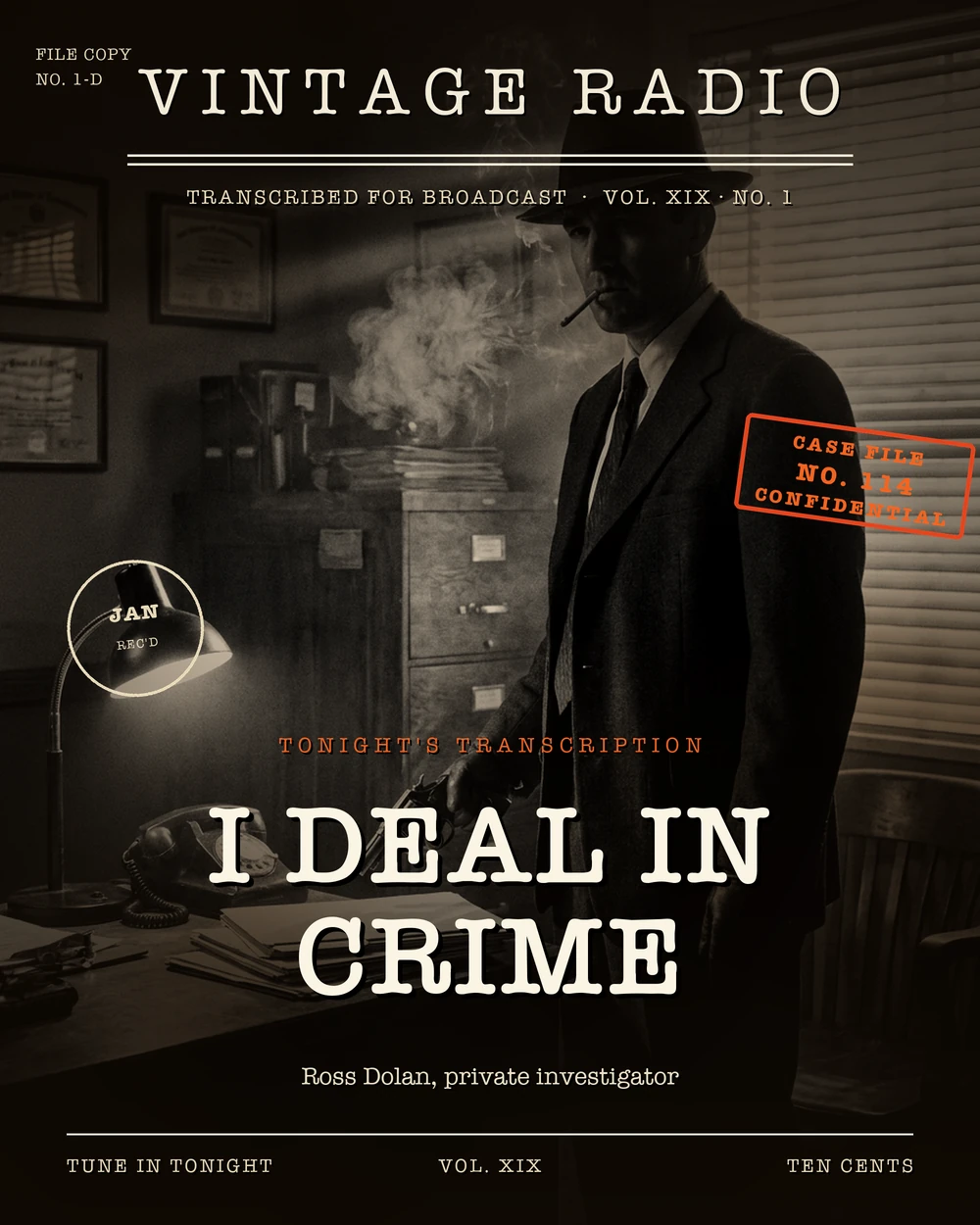
I Deal in Crime
The Show and What It Was
When I Deal in Crime premiered on ABC on January 21, 1946, hard-boiled detective stories were flooding the airwaves. What set this one apart was its lead: William Gargan playing Ross Dolan, a veteran private eye back from a stint in what the show called "Uncle Sugar's Navy," returning to his old haunts to again deal in crime. Dolan operated out of the 404 Melrose Building, took cases that put him in the middle of gang violence and criminal intrigue, and narrated the whole thing in a clipped, first-person style that became the show's signature. According to the Great Detectives of Old Time Radio, the series gave the fledgling ABC network a leg up on the rush to hard-boiled detective programming in the mid-1940s, arriving alongside another ABC entry, The Fat Man with J. Scott Smart.
The show ran Mondays at 9 through October 1946, shifted to Saturdays at 8:30, and from May 1947 moved to Saturdays at 8. When the ABC run ended on October 18, 1947, the series crossed to the Mutual Broadcasting System the following week, airing under the new title Ross Dolan, Detective from October 25, 1947 through September 4, 1948. Ted Hediger wrote the scripts, Leonard Reeg directed, Dresser Dahlstead announced, and Skitch Henderson provided the music. Each episode ran thirty minutes.
Why Gargan Was the Right Man for It
William Gargan wasn't pretending to know how a private detective worked. Before he became an actor, he had actually worked as one with a Wall Street agency — and got fired after losing the tail on a subject he was supposed to follow. That practical, slightly humbling background gave his Ross Dolan a texture hard to manufacture. He is believed to have been the only actor who played private eyes on radio, film, and television while having genuinely been one in real life.
By 1946, Gargan had a 1941 Academy Award nomination for Best Supporting Actor for They Knew What They Wanted, three Ellery Queen films for Columbia in 1942 (taking over from Ralph Bellamy), and a first regular radio role as Captain Flagg on Captain Flagg and Sergeant Quirt dating to February 1942. I Deal in Crime was where he found his footing as a radio detective. Adam Graham, host of the Great Detectives of Old Time Radio podcast, noted that the earliest episodes showed Gargan playing Dolan in an "over the top" register, but by September 1946 Dolan had become more laid back — closer to the style Gargan would later bring to Martin Kane, Private Eye starting in 1949, and then to Barrie Craig, Confidential Investigator on NBC from 1951 to 1955. Graham argued that I Deal in Crime was "probably vital in Gargan's career in helping him develop the type of detective character that would keep him in demand for years to come."
In 1958 Gargan was diagnosed with throat cancer, and his larynx was removed in 1960, ending his acting career. He became a spokesperson for the American Cancer Society, warning about the dangers of smoking. He published his autobiography, Why Me?, through Doubleday in 1969, received the Screen Actors Guild Life Achievement Award in 1967 — the fifth person ever to receive it — and died February 16, 1979, of a heart attack on a flight from New York to San Diego.
The Rest of the Production Team
Skitch Henderson, who handled the show's music, was at an early and busy point in his career during the I Deal in Crime run. Born Lyle Russel Henderson in Halstad, Minnesota on January 27, 1918 — though he often claimed Birmingham, England — he had recently formed his own orchestra and signed a recording contract with Capitol Records. The nickname "Skitch" came from his ability to re-sketch a song in a different key, a name Bing Crosby suggested he use professionally. While working on this show, he was also accompanist on Philco Radio Time with Crosby on ABC and musical director on Frank Sinatra's Light-Up Time on NBC. He later spent fifteen years as conductor for The Tonight Show under Steve Allen and Johnny Carson, and in 1983 founded The New York Pops at Carnegie Hall, where he remained until his death on November 1, 2005.
Announcer Dresser Dahlstead had a long history with the network before I Deal in Crime. Born in Springville, Utah on September 19, 1910, he started in radio at an NBC affiliate in San Francisco at nineteen, moved to NBC Hollywood in 1938, became chief announcer at NBC Blue in 1942, and transitioned to ABC in 1944 when the Blue network became ABC. His other credits included I Love a Mystery, One Man's Family, Death Valley Days, and The Fitch Bandwagon. After radio, he served as ABC Western Division program director from 1951 to 1959, then joined Ralph Edwards Productions, where he announced the syndicated television version of Truth or Consequences from 1966 to 1974.
What Survives
Only three transcribed episodes are known to have survived — one from January 1946, one from April 1946, and one from September 1946 — and OTR researcher Jack French, writing for The Thrilling Detective website, has documented that these three are the extent of what remains, traded among collectors. They give a reasonable cross-section of what the show dealt in: Dolan hired to guard a New England matron crossing town while someone shoots at them and a body turns up (informally known as "The Abigail Murray Case"); Dolan hired to find a client's runaway seventeen-year-old daughter, with someone working to block him; and Dolan, fresh back from his wartime service, taking on a job for a woman wanting protection from killing her husband. Small cases on paper, but each built around the first-person narration and the hard-boiled sensibility the show kept consistent across its run.